Our Story
Lumber Minneapolis was born from a simple refusal to let good wood go to waste. What began with a single barn dismantle has grown into the Twin Cities' most trusted source for reclaimed lumber.
Where Every Board Gets a Second Chance
Our journey from one barn salvage to 500K+ board feet annually
A Truckload of Barn Wood Changed Everything
In 2018, a farmer south of the metro needed a century-old dairy barn taken down. The demolition company quoted him a price, and the plan was straightforward: knock it down, haul it off, dump it. Thousands of board feet of tight-grain, old-growth timber — wood that took over a hundred years to grow and another hundred to season — headed for a landfill.
We offered an alternative. We would dismantle the barn by hand, salvage every usable board, and haul it away at no cost to the farmer. It was more labor, more time, and more care — but the result was extraordinary. The wood was stunning: dense heart pine with a patina no stain can replicate, white oak beams with the kind of structural integrity that made them load-bearing for a century.
That first barn was the proof of concept. The wood sold fast. The customers were thrilled. And we realized that across Minnesota, the same story was playing out every week — beautiful old timber being destroyed because no one was set up to save it. So we built the company to do exactly that.
The Founding Conviction
“The most sustainable lumber is the lumber that already exists. It does not need to be planted, grown, harvested, or kiln-dried. It just needs someone willing to do the careful work of recovering it.”
That idea — that used wood is an asset, not waste — became the foundation of everything we do. It drives our sourcing, our pricing, our processing standards, and our environmental commitments.
We are not a trendy reclaimed-wood boutique. We are a working lumber yard that handles serious volume, serves real construction projects, and happens to do it with materials that have already lived a full first life.
Minneapolis: Built on Lumber
To understand why reclaimed lumber matters in Minneapolis, you need to understand the city's history with wood. In the late 19th century, Minneapolis was the lumber capital of the world. The city's position at the Falls of Saint Anthony on the Mississippi River made it the natural processing hub for the vast white pine forests of northern Minnesota and Wisconsin.
At its peak in the 1890s, Minneapolis sawmills processed over 600 million board feet of lumber per year. The wood flowed downstream from logging camps in the north, was sawed at mills along the river, and was used to build not just Minneapolis but cities across the Great Plains. The warehouses, factories, grain elevators, and homes built during that era used old-growth timber of extraordinary quality — tight-grained white pine, dense Douglas fir, and hardwoods that had grown slowly in dense forest canopy for 200 to 400 years.
Many of those structures are still standing today. And as the city grows and redevelops, they are coming down — replaced by modern construction. The lumber inside them is the last remnant of those original forests. Once it goes to a landfill, that material is gone forever. There are no more first-growth forests in Minnesota to replace it.
We see our work as a continuation of that lumber legacy. The wood we salvage from Minneapolis warehouses, Saint Paul factories, and rural Minnesota barns is the same old-growth timber that built this region. By recovering it and putting it back into modern buildings, we are preserving a tangible connection to the city's founding industry.
From Garage to Lumber Yard
After that first barn in Northfield, word spread faster than we expected. A contractor renovating a house in Saint Paul had old-growth pine joists he wanted to sell. A property owner in Northeast Minneapolis was tearing down a detached garage and had a stack of redwood siding. A farmer near Red Wing had two grain bins with Douglas fir framing. Within three months of our first salvage, we were running out of space.
The early operation was a two-car garage, a pickup truck, and a pile of crowbars. De-nailing happened by hand on sawhorses in the driveway. Grading was done by eye, with species identified by a worn copy of a wood identification field guide. Deliveries were personal — we loaded boards into the truck bed and drove them to the customer ourselves. It was not efficient, but it was thorough. Every board got individual attention because there was nobody else to handle it.
By early 2019, it was clear that the garage operation could not scale to meet demand. We needed a real yard with room for inventory staging, a covered processing area, and space for milling equipment. We found it at 2366 Rose Pl W in Roseville — a light-industrial facility with enough square footage for a processing line, storage racks, and a small retail area. Opening that yard was the moment Lumber Minneapolis became a real business.
Milestones Along the Way
From a farmer's barn to a full-service reclaimed lumber operation — every year has brought new capabilities, new partnerships, and more wood saved from the landfill.
The First Barn
It started with a century-old dairy barn in Northfield, Minnesota, scheduled for demolition. Instead of watching that old-growth timber hit a landfill, we spent two weeks carefully dismantling it board by board. The yield: over 8,000 board feet of heart pine, white oak, and Douglas fir — wood with grain density and character that modern lumber simply cannot replicate. We sold every last piece within a month.
Opening the Roseville Yard
Demand outpaced our garage operation within months. We secured our current facility at 2366 Rose Pl W in Roseville — a space large enough to store, process, and mill reclaimed lumber at meaningful scale. The yard gave us room for a de-nailing station, a sorting area, and our first planer. More importantly, it gave contractors and designers a place to come browse inventory in person.
Building the Processing Line
We invested in professional milling equipment: a wide-belt sander, a 20-inch thickness planer, and a resaw bandsaw built to handle the nail-scarred, case-hardened timber that reclaimed work demands. This equipment allowed us to offer custom milling services — transforming rough salvaged beams into precision-dimensioned flooring, siding, and architectural elements.
Deconstruction Services Launch
We began offering full building deconstruction as a service, partnering with contractors and property owners who wanted to salvage materials rather than demolish. Our first major project was a 1920s warehouse in Northeast Minneapolis that yielded over 40,000 board feet of old-growth lumber, plus thousands of period bricks and vintage hardware.
Environmental Impact Certification
We launched our Environmental Impact Certificate program, giving customers verifiable data on the trees saved, carbon offset, and landfill waste diverted by their purchase. The program resonated immediately — architects and builders began specifying reclaimed lumber on projects partly because they could document the environmental benefit for LEED and green building certifications.
Half-Million Board Feet Milestone
We crossed the threshold of 500,000 board feet salvaged and processed in a single year. By this point, our inventory included reclaimed lumber from over 120 distinct structures across Minnesota, Wisconsin, and Iowa — each lot tracked with provenance data documenting where the wood came from and what building it was part of.
Custom Fabrication & Delivery Fleet
We expanded into custom fabrication — building barn doors, mantels, conference tables, and accent walls from our reclaimed stock — and added a dedicated flatbed delivery fleet to serve the entire Twin Cities metro. These additions closed the last gaps in our service chain: we now handle everything from salvage to finished product to doorstep delivery.
Two Million Board Feet & Growing
We surpassed two million total board feet salvaged since our founding. Our operation now supports over 40 LEED-certified or green building projects annually, and our Environmental Impact Certificates have documented the prevention of over 7.2 million pounds of CO₂ emissions. The demand for reclaimed lumber continues to accelerate as architects, builders, and homeowners recognize both the environmental and aesthetic value of salvaged wood.
A Personal Note
“I have been asked many times why I started a reclaimed lumber company. The honest answer is that it started with anger. I was watching a demolition crew knock down a beautiful old warehouse in Northeast Minneapolis, and the lumber — massive Douglas fir beams, tight-grain pine planking, white oak flooring — was being crushed into a dumpster. It made no sense. That wood was stronger, denser, and more beautiful than anything you could buy at a lumber yard. And it was headed for a landfill.”
“The first year was chaos. I did not know how to run a business. I barely knew how to identify species. I broke tools, underpriced jobs, and made every mistake in the book. But I learned that the wood itself was the teacher. Every board has a story — where it grew, how it was milled, what building it held up, and what hands had touched it before mine. That story is what makes reclaimed lumber special, and it is what keeps me doing this work.”
“Today, our team handles hundreds of thousands of board feet per year. We have a real shop, real equipment, and real customers who depend on us. But the conviction has not changed: used wood is not waste. It is a resource. And the most sustainable board you can put in a building is one that has already been in a building. If that idea resonates with you, come visit our yard. I would love to show you what we do.”
What Years of Salvage Taught Us
Old Growth Is Irreplaceable
The lumber in pre-1950 buildings was harvested from first-growth forests that took 200 to 400 years to mature. That wood has tighter grain, greater density, and higher dimensional stability than anything milled from modern plantation timber. When those boards hit a landfill, that quality is gone forever. We have seen Douglas fir beams from 1890s grain elevators that test harder than new-growth oak. That kind of material deserves a second life.
Character Cannot Be Manufactured
Nail holes, saw marks, checking, weathering, and patina — these marks are why architects and designers choose reclaimed wood. Every scratch tells a story. We have processed lumber with hand-stamped mill marks from the 1880s, pencil notations from carpenters who built wartime factories, and bolt patterns that show exactly how a timber-frame barn was put together. No distressing technique can replicate that authenticity.
Careful Deconstruction Pays Off
Mechanical demolition destroys 60 to 80 percent of recoverable lumber. Hand deconstruction preserves it. Yes, it takes longer. Yes, it costs more upfront. But the material yield is dramatically higher, and the value of intact reclaimed boards far exceeds the cost of the extra labor. We have consistently proven that careful deconstruction is not just better for the environment — it is better economics.
Local Sourcing Matters
Shipping lumber across the country burns fuel and erases much of the carbon benefit of reclaiming it. We source 95 percent of our inventory from within 150 miles of Minneapolis. That means shorter haul distances, lower transport emissions, and a genuine connection between the building that donated the wood and the project that receives it. Our customers get materials with local provenance, not anonymous commodity stock.
The Wood Inside Minnesota's Old Buildings
Every deconstruction project is a discovery. The species mix inside a century-old Minnesota structure tells the story of where the builders sourced their materials and what was available at the time. Here is what we most commonly find — and what makes each species special in its reclaimed form.
Longleaf Pine (Heart Pine)
The most prized species we recover. Longleaf pine was the dominant structural and flooring timber in construction from the 1850s through the 1920s. The old-growth trees grew slowly in dense stands across the southeastern United States, producing wood with 12 to 20 growth rings per inch. The heartwood is saturated with natural resins that give it extraordinary hardness (Janka 1,225 lbf) and a rich amber color that deepens over time. Longleaf pine forests were virtually exhausted by the 1930s — making reclaimed heart pine an irreplaceable resource.
Douglas Fir
The structural backbone of industrial construction in the upper Midwest. Douglas fir beams from the Pacific Northwest were shipped by rail to Minneapolis for use in warehouses, grain elevators, bridges, and heavy commercial buildings. Reclaimed Douglas fir is recognizable by its tight, vertical grain and warm reddish-brown color. It has an exceptional strength-to-weight ratio, making it ideal for exposed beam applications where both aesthetics and load-bearing capacity matter.
White Oak
Minnesota's native white oak was heavily used in residential and commercial construction across the Twin Cities. We find it in flooring, stair treads, window frames, and structural framing. Reclaimed white oak has a Janka hardness of 1,360 lbf and is naturally rot-resistant due to tyloses that block the wood pores. This makes it excellent for both interior and exterior applications — from bar tops to garden beds.
White Pine
The species that built Minneapolis. Minnesota's white pine forests fueled the sawmill industry that made the city the lumber capital of the world in the 1890s. Old-growth white pine has a significantly tighter grain than modern plantation-grown white pine, with greater stability and a warm, honey-toned color. We find it most often in barn siding, interior paneling, and tongue-and-groove flooring from pre-1940 construction.
Memorable Recoveries
Every structure we deconstruct has a story. Some of the most memorable recoveries we have done illustrate why this work matters — and why the material we save is worth the effort.
The Northeast Warehouse (2021)
Our largest single-structure recovery. A 1920s industrial warehouse in Northeast Minneapolis was slated for demolition to make way for a mixed-use development. The building contained over 40,000 board feet of old-growth Douglas fir beams, heart pine flooring, and white oak structural framing. The deconstruction took six weeks and required a crew of eight. The yield was extraordinary — some of the Douglas fir beams measured 12x16 inches and spanned 30 feet without a joint. That material has since gone into restaurant interiors, residential renovations, and custom furniture projects across the Twin Cities.
The Northfield Dairy Barn (2018)
The barn that started it all. This century-old dairy barn contained roughly 8,000 board feet of heart pine, white oak, and Douglas fir — all tight-grain, old-growth material that had been seasoning in place for over 100 years. Dismantling it by hand took two full weeks, but the wood was in remarkable condition. The original hand-hewn beams still showed the adze marks from the carpenter who shaped them. Every board from that barn sold within a month, and the experience convinced us that there was a real market for carefully recovered reclaimed lumber.
The Red Wing Grain Elevator (2022)
A decommissioned grain elevator in Red Wing yielded some of the densest Douglas fir we have ever processed. The vertical timbers had been under compression for nearly 90 years, and the grain was so tight that our planer needed three passes at reduced feed rate to surface them. The resulting material — rich amber fir with a glass-smooth surface and visible growth rings packed at 18 per inch — became the feature wood for a high-end restaurant renovation in downtown Minneapolis.
The Elm Grove Urban Salvage (2023)
When a block of mature American elms in south Minneapolis was removed due to Dutch elm disease, the city arborist contacted us. Rather than chipping the trees, we recovered over 3,000 board feet of elm lumber. American elm has a distinctive interlocking grain that makes it nearly impossible to split — a quality that made it historically popular for wagon wheel hubs and boat keels. We milled the logs into slabs and dimensional stock that went into custom tabletops, cutting boards, and decorative panels. It was a reminder that reclaimed lumber does not always come from buildings.
Challenges We Have Overcome
Building a reclaimed lumber company from scratch meant solving problems that no textbook covers. Here are some of the biggest obstacles we have faced — and how we addressed them.
The Hidden Metal Problem
One of the biggest challenges in reclaimed lumber is hidden metal. Nails, screws, bolts, and staples buried deep inside boards can destroy planer blades, bandsaw teeth, and — worst of all — cause injuries. Early on, we learned this lesson the hard way when a buried lag bolt shattered a planer blade on our third day of operations. That incident led us to invest in electromagnetic metal detectors and establish our policy of scanning every board on all faces and edges before it goes anywhere near a milling machine.
Inventory Unpredictability
Unlike a conventional lumber yard that orders from a supplier catalogue, our inventory depends on what buildings are coming down and what lumber they contain. Some months we are flush with white oak; other months, we cannot find any. Learning to manage this unpredictability required us to build deeper inventory reserves, diversify our sourcing relationships, and educate customers about the realities of reclaimed supply. Today, we maintain over 100,000 board feet in stock to buffer against supply fluctuations.
Educating the Market
When we started, many contractors viewed reclaimed lumber as a niche product for decorative use only. Convincing builders that reclaimed wood could serve as structural framing, subfloor material, and precision-milled finish products required demonstration, education, and a track record of reliable supply. Our quarterly builder workshops and yard tours have been instrumental in changing perceptions — once a contractor sees our processing line and holds a piece of century-old heart pine, the quality speaks for itself.
Scaling Without Compromising Quality
Growing from a one-truck operation to a 500,000-board-foot-per-year business meant scaling every part of our process — sourcing, transport, processing, grading, storage, and delivery. The temptation when scaling is to cut corners, especially on labor-intensive steps like hand de-nailing and individual board grading. We have resisted that temptation consistently, investing in more people and better equipment rather than accepting lower quality standards. Every board still gets the same inspection, the same metal scan, and the same grading attention it got when we were processing 10 boards a day.
Relationships That Made Us Stronger
Reclaimed lumber is a network business. The quality and volume of material we can offer depends on the relationships we have built with contractors, organizations, and institutions across the region.
Demolition Contractors
We work with over 30 demolition and renovation contractors across the Twin Cities metro. These relationships give us early access to buildings slated for demolition, allowing us to evaluate and bid on lumber before structures come down. Many of our contractor partners now default to deconstruction rather than mechanical demolition when the building contains salvageable timber.
Architecture & Design Firms
Several Twin Cities architecture and interior design firms have made Lumber Minneapolis their primary reclaimed wood source. We provide material samples, spec sheets, and Environmental Impact Certificates that architects need for project documentation. Some firms bring clients to our yard to select material in person — an experience that helps sell the story behind reclaimed wood.
Hennepin County Waste Reduction
Our partnership with Hennepin County's waste reduction programs has been one of the most impactful relationships we have built. The county promotes deconstruction as an alternative to demolition, and we are one of the recommended reclaimed lumber processors in the region. This partnership has increased public awareness of reclaimed lumber as a viable building material.
Local Farms & Composting Operations
The sawdust and wood shavings generated by our milling operation go to local farms in Dakota and Scott counties. Farmers use the material for animal bedding and composting. This closes the loop on our processing waste and ensures that even our milling byproducts serve a productive purpose.
Habitat for Humanity ReStore
Material that does not meet our retail standards — pieces with too much damage for architectural applications but still structurally sound — is donated to Habitat for Humanity ReStore locations in the Twin Cities. This keeps usable wood out of landfills and supports affordable housing construction.
University of Minnesota Research
We have collaborated with researchers at the University of Minnesota on projects related to reclaimed wood characterization, species identification of aged timber, and the mechanical properties of old-growth lumber. These research relationships help us refine our grading standards and contribute to the broader body of knowledge about reclaimed building materials.
Why We Believe in Reclaimed
Sustainability is not a marketing angle for us. It is the foundational logic of the business. Reclaimed lumber makes sense on every level — environmental, economic, and aesthetic. The environmental case is straightforward: every board foot we salvage prevents carbon emissions, preserves standing forests, and diverts material from landfills. We have the data to prove it, and we publish those numbers openly.
The economic case is equally strong. Old-growth lumber is genuinely superior to plantation-grown timber in density, hardness, and dimensional stability. Customers pay for reclaimed wood not out of charity but because it performs better and looks better. The premium reflects real quality, not just a green label.
And the aesthetic case needs no argument. Anyone who has seen a reclaimed heart pine floor beside a new pine floor understands immediately. The depth of color, the tight grain, the story written in every nail hole and saw mark — these qualities cannot be manufactured. They can only be recovered.
The Environmental Argument
Every board foot of reclaimed lumber prevents ~3.6 lbs of CO₂ emissions compared to new lumber. At our annual volume, that is 1.8 million pounds of carbon kept out of the atmosphere — equivalent to taking 180 cars off the road for a year.
The Quality Argument
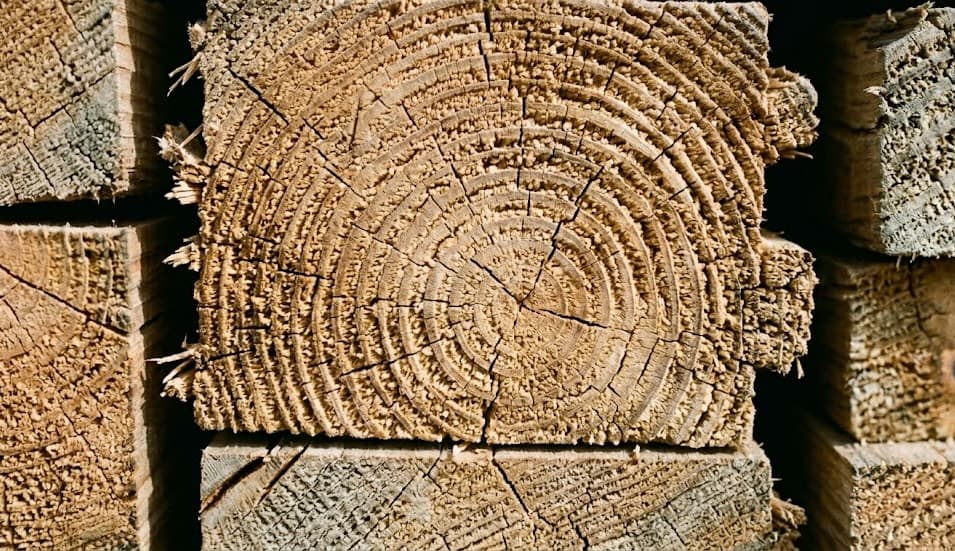
Old-growth timber has 12-20 growth rings per inch compared to 3-6 for plantation lumber. That density translates to greater hardness, better nail-holding capacity, and superior dimensional stability. Reclaimed heart pine tests at approximately 1,225 lbf on the Janka scale — nearly double new-growth pine.
The Aesthetic Argument
Patina, character marks, and authentic aging create visual depth that no factory distressing can replicate. The wood carries the marks of its history — hand-hewn tool marks, original mill saw patterns, and the slow color development that comes from decades of exposure.
What People Say About Working with Us
Our reputation has been built one project at a time. Here is what our customers have shared about their experience.
“The quality of the reclaimed heart pine flooring from Lumber Minneapolis is in a different league from anything we have installed from conventional suppliers. The grain density, color, and consistency were exceptional — and our client was blown away by the Environmental Impact Certificate that came with the order.”
Ryan T.
Custom Home Builder, Edina
“We designed a restaurant interior around reclaimed white oak from Lumber Minneapolis. The material arrived exactly as specified — de-nailed, surfaced, and graded. No surprises, no hidden nails, no warped boards. That reliability is why we keep coming back.”
Michelle K.
Interior Designer, Minneapolis
“I was renovating my 1920s bungalow and needed flooring that matched the original. Lumber Minneapolis found heart pine with the right grain pattern and color match. They milled it to tongue-and-groove at the exact thickness I needed. The finished floor is seamless — you cannot tell where the old stops and the new begins.”
Karen W.
Homeowner, Saint Paul
“We had 5,000 board feet of old framing lumber from a warehouse demo that we did not know what to do with. Lumber Minneapolis came out, evaluated it on-site, gave us a fair price, and hauled it all in one trip. Easiest part of that whole project.”
Brian H.
Demolition Contractor, Twin Cities
Vision for the Future
We are not done growing. The supply of reclaimable lumber in the upper Midwest is enormous — Minnesota alone has thousands of barns, warehouses, and pre-war structures containing millions of board feet of salvageable timber. The challenge is scaling our operation to recover more of that material before it is lost.
Our near-term goals include expanding our processing capacity to handle over 750,000 board feet per year, adding kiln-drying capability for customers who need certified moisture content, and building out our delivery fleet to serve a wider geographic radius. We are also developing a digital inventory system that will allow customers to browse available material online, view photos and species data, and place orders remotely.
Longer term, we want to be part of a regional reclaimed lumber network — connecting salvage operations, processing facilities, and end users across the upper Midwest to maximize the recovery of usable timber from demolition and renovation projects. The more we can recover, the fewer trees need to be harvested. That is the goal.
Board feet per year — our processing capacity target
Planned addition for certified moisture content capability
Online browsing with species data, photos, and remote ordering
Where We Stand Now
Today, Lumber Minneapolis operates from our Roseville yard at 2366 Rose Pl W, where we maintain a rotating inventory of over 100,000 board feet of inspected, graded reclaimed lumber. We serve general contractors, custom home builders, interior designers, furniture makers, and DIY homeowners across the Twin Cities and beyond.
Our team handles the complete lifecycle: we buy used lumber, deconstruct buildings to recover it, de-nail and process it in our shop, mill it to customer specifications, and deliver it on our own flatbed trucks. That end-to-end capability means one point of contact, one quality standard, and full chain-of-custody from source structure to finished project.
Board feet per year
Source structures
Projects supplied
BF in inventory
The Next Chapter Is Being Written Now
Every board we save, every project we supply, and every tree that stays standing because of reclaimed lumber — that is the story we are writing. We would love for your project to be part of it.